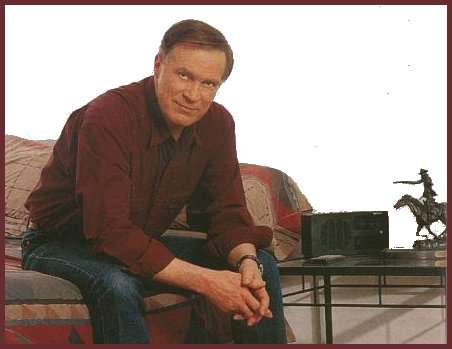
Clint moved to California at the age of 16, but there were many detours on his road to stardom. “I was too shy,” Clint admitted. “I went to San Jose, where I had a variety of jobs, including truck driver, service station attendant, construction worker in a furniture factory, bartender (until they discovered his age — 19) and health club/gym manager.”
Eventually, Clint realized that in order to become an actor, he had to be where the “action” was, so he moved to Southern California. Still, it took him two years to work up the courage to attend an acting class, but his life changed as soon as he did. He landed a six-month contract with Columbia Pictures and the lead role in a one-act presentation of “One Flew Over the Cuckoo’s Nest” after studying with the esteemed Estelle Harman for two years. His turn as “Randall Patrick McMurphey” led to a seven-year contract at Twentieth Century Fox. (Jack Nicholson would later play the role in the 1975 motion picture adaptation.)
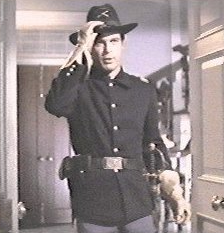
In 1965, Clint earned his Screen Actors Guild membership portraying “The Lieutenant” in the pilot for the popular television series “The Wild Wild West.” “That got me back into horses,” he recalled. He began training them for other people while he solidified his career with roles in films such as:
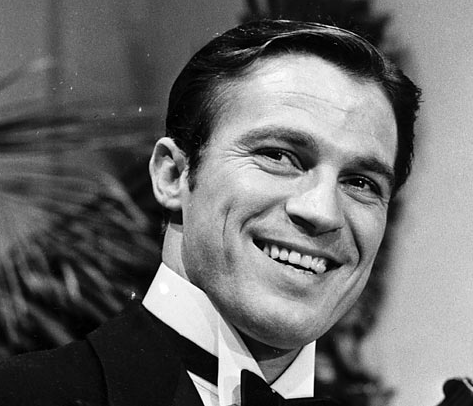
- The St. Valentine’s Day Massacre (Jack McGurn, 1967)
- Bandolero (Babe Jenkins, 1968)
- Patton (Tank captain, 1970)
- Joe Kid (Deputy Sheriff Calvin, 1972)
- A Force of One (Melrose, 1977).
“They were all enjoyable experiences,” Clint reflected.
Around 1970, Clint and many other contract players such as Tom Selleck (it was Clint who taught Tom to ride a horse), Lyle Waggoner, Sam Elliott, and Jacqueline Bisset were released from their contracts with Twentieth Century Fox as a result of budget cuts. It was a new era in Hollywood — the old “studio system” was a thing of the past. Clint moved to the San Fernando Valley where he worked extensively with horses, trying to convince himself that he was happy. Without even realizing it, though, he had withdrawn from his chosen profession.
In 1975, Clint signed with a new agent and began acting again, primarily in commercials and episodic television series, including:
- Police Story
- Batman
- Felony Squad
- Dallas
- Three Desperate Women (television movie)
- Centennial (television mini-series).
Clint always loved horses. In 1982, he and his favorite mount, Hammer, entered and completed the Western States Trail Ride, popularly known as the Tevis Cup Ride. Riders cover the rugged trail from Lake Tahoe to Auburn, California in a single day, earning a silver belt buckle that he proudly wore constantly for the rest of his life. He also completed many 50 mile endurance rides.
Writing was another favorite of Clint’s favorite pastimes. He wrote a screenplay based on the true story of Francois Aubry, whom Clint described as “the greatest long distance horseman who ever lived.”
But Clint’s life would be forever changed when he was given an eleven-page scene and character breakdown with which to prepare to audition for the role of “Chris Logan.” Unaware that the scene was from a daytime soap taped in New York City, Clint instantly recognized that he was right for the part. Barbara Remsen, “One Life to Live’s” then-casting director, was looking for an “outdoors newspaperman” to play the man hand-picked by the character of “Joe Riley,” the editor-in-chief of fictional Llanview, Pennsylvania’s newspaper, The Banner, to serve as his replacement. She liked what she saw in Clint the moment he arrived for the audition in cowboy attire. When Clint assured Ms. Remsen that he would not mind sharing his name with his character, “Chris Logan” became “Clint Logan.” By the time Clint reported for work, his character’s surname had been changed to “Buchanan.”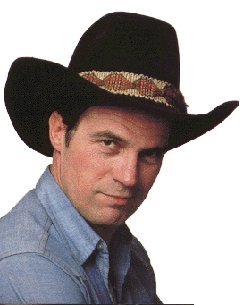
Over the years, sharing the same first name, as well as many personal characteristics, caused the line between the fictional character and the man portraying him to blur for many viewers. With good reason. Clint Ritchie and his fictional counterpart shared many core characteristics, values, and philosophies about life.
It was on September 10, 1979, that Clint’s first scene on “One Life to Live” aired. Thinking the job would last about thirteen weeks, he didn’t even bother to unpack when he arrived in New York. Having worked in films and prime time television, “I had no idea they did a complete show each day or that you were expected to learn the amount of dialogue we learned. When I did a movie, we took ten weeks to shoot it, and I’d have only two or three pages of dialogue a day. I remember one day Erika Slezak and I had over 50 pages of dialogue, and we did it,” Clint recollected.
Within a year of joining “One Life To Live,” Clint realized another long-held dream: He purchased “Happy Horse Ranch,” situated near Grass Valley in Northern California in 1980. Over the years, Clint purchased properties adjacent to the original property, so that the Ranch eventually consisted of approximately 60 acres. During his remaining tenure with ABC, he flew home to California as often as possible when he wasn’t needed in front of the cameras in New York.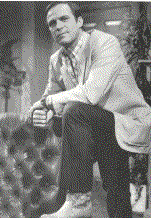
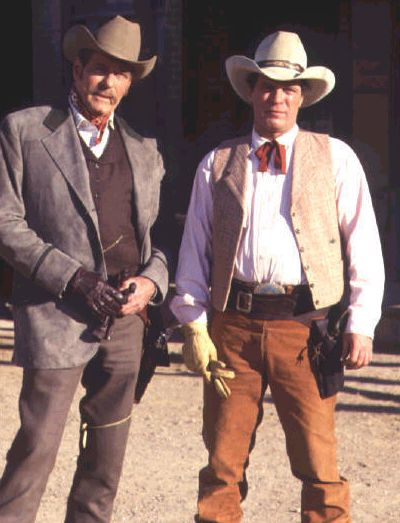
Far and away, Clint’s favorite storyline on “One Life to Live” was 1988’s Old West adventure. Filmed on location in Arizona, Clint transported six of his own horses to the set, reveling in the chance to be a cowboy on camera.
In the story, “Clint Buchanan” and family moved to his Arizona ranch after he was blinded. Determined not to be dependent upon his family, Clint rode out into the desert on Okie (portrayed by Clint’s horse, Okie Dokie). Thrown from his horse, Clint awakened to find that his sight was restored, but he was in a town called Buchanan City — in the year 1888.
Meanwhile, his family believed that he was dead and attempted to move on with their lives. But his wife “Viki’s” intense emotional and spiritual connection to her husband convinced her that he was alive and she had to search for him. “Viki” found her way back to 1888 and “Mr. and Mrs. B.” were reunited. By that time, having given up on ever being able to return home, “Clint Buchanan” was about to marry “Viki’s” great-great-grandmother, “Ginny.” In one of the story’s most memorable scenes, “Viki” found her way to the saloon where the wedding was taking place — and interrupted it. “Ginny” was reunited with “Randolph Lord” so that history could unfold as it was always meant to, and with the assistance of an old Native American named “Clear Eyes,” “Clint” and “Viki” were transported back to their present-day home.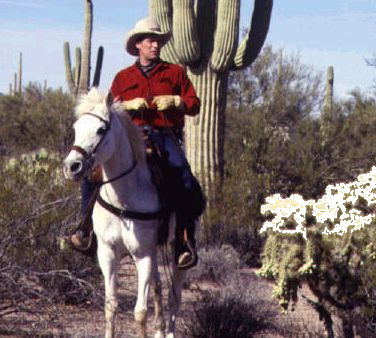
On May 10, 1993, Clint was at home enjoying some much-needed time off. Riding his classic John Deere tractor, he spied what appeared to him to be a six-inch tree stump in his path. He figured he could easily clear it. But the tractor, pulling a spike-tooth harrow, began climbing up the stump — which turned out to be 18 inches tall — and began listing right. Afraid it would overturn, Clint stood up to leap off. But just then the tractor righted itself, pitching him to the ground directly in its path. “I realized I was going to get run over,” Clint remembered. On his belly, inches from the advancing 5,000-pound machine, he could do nothing but brace himself for the impact — first from the smaller front wheels, then from the slow, agonizing crush of the immense rear wheels. “It took forever,” he said. “I heard and felt bones breaking like toothpicks.” He knew the spike-tooth harrow was next. “So I got to my feet and it caught me, but I managed to throw it off, because I was right at the edge of it,” he later recounted. “Tore up my arms a bit, but not terrible.”
He sustained life-threatening injuries — his right collarbone was broken, as were his right shoulder blade, all the ribs on his right side, and several on his left. Fortunately, Clint had decided at the last minute to take his cell phone with him. Despite the fact that both of his lungs had collapsed, he was able to direct confused paramedics to his location on the Ranch before losing consciousness. He was treated at the University of California, Davis, Medical Center in Sacramento before returning to the Ranch to convalesce. He credited the doctors and nurses at the Medical Center with saving his life.
Clint’s recuperation required him to be away from the “One Life to Live” studios for many weeks during which time he was overwhelmed by the outpouring of love and support he received from both fans and coworkers. He was visited at the Ranch by, among others, Robert S. Woods (“Bo Buchanan”). His co-star, Erika Slezak (“Viki”), implored the show’s producers not to recast the role. “We’ll do whatever you need,” she told then-Producer Linda Gottlieb, “but please don’t have anyone else play his role.” Gottlieb assured Clint that his job was waiting for him, even if he was confined to a wheelchair. “You don’t think about that kind of thing between employer and employee anymore,” Clint said. “It was the kind of stuff you hear about happening 100 years ago, when people cared about people.” The show’s writers concocted a storyline that accounted for “Clint Buchanan’s” absence: He was injured in an airplane crash and recovered at his “Happy Horse Ranch” in Arizona. (The character’s ranch was given the same name as Clint’s own Northern California spread.) When Clint was well enough to return to New York City and resume work, “Clint Buchanan” was also deemed well enough to return home where both Clints received heart-felt welcomes!
Clint’s initial thirteen-week contract evolved into more than 20 years portraying “Clint Buchanan,” during which every spare moment was devoted to running Happy Horse Ranch. But eventually, the long distance oversight of everything from the caretaking of his many animals to major building renovations and the supervision of his employees became increasingly difficult.
Like his fans, Clint became dismayed and disheartened by the manner in which his character was scripted in the early to mid 1990’s, especially when the writers opted to have “Clint and Viki Buchanan” divorce. Later, former “One Life To Live” Head Writer Michael Malone explained:
Question: When you decided to break up Clint and Viki Buchanan (“One Life to Live”) many long time fans were upset. Was it ever your intention to reunite them — some place down the road?
Answer: Breaking up a couple as firmly established in a marriage as Clint and Viki Buchanan can feel as traumatic to writers as the collapse of a marriage of real friends or family. That’s how everyone at One Life felt when we made the decision to explore the dramatic possibilities in a mid-age extra-marital affair for Viki. We did so at a time when she was emotionally vulnerable because she had lost her daughter Megan, . . . Here was tremendous dramatic potential in such a story because Viki and Clint were such good people, had been through so much together, had shared children and a home, shared professions (running The Banner together), and were both highly moral, fair, faithful leaders of their community.
. . . Viki’s leading [Andrew Carpenter’s father] to a more compassionate, tolerant view of his homosexual son’s death from AIDS (she ultimately persuaded him to join her in placing a panel in the quilt), evoked in them feelings for each other that both worked long and hard to suppress because of Viki’s commitment to her marriage. At the same time, Clint took a different moral position on the issue and that distanced him from Viki. And at the same time, Dorian began in her inimitable way, to do everything she could to ferment jealousy.
All these threads worked to create drama: Viki’s moral torture, Clint’s pain, the children’s distress, [the father’s] evolution from a cold, withdrawn man to a loving heart — all gave us rich sources of story for months and months.
. . . Clint and Viki were able to reconnect and to sustain a friendship based on a love deeper than their hurt and loss, as Viki was struck by [her new husband’s] critical illness and death.
But you know what? There is one moment I remember vividly that suggests to me an inevitable move back together of Clint and Viki. As least in the pure narrative sense (I mean, taking away all the external factors that control story in daytime — actors move to Hollywood, networks cut costs, contract negotiations fail, recasts don’t work, etc.) That moment was a shot of Clint (tired and unhappy) walking up the stairs to be with a crying Jessica during the time when he and Viki were working out the divorce. I always thought of it as the “John Wayne in The Man Who Shot Liberty Valence” shot–it revealed Clint as the quiet man who would never stop loving a woman his whole life long. And that makes the audience hope that someday, some way, maybe she’d come back to him.
Sadly, it was not to be. In 1998, Clint decided it was time to “hang up” his “acting spurs” and permanently retire at Happy Horse Ranch. He taped his final episode in early December 1998, but barely had time to adjust to the Pacific time zone when he was coaxed out of retirement to again portray “Clint Buchanan” in April 1999. To his delight, the scripts reflected restored “Clint Buchanan’s” original characteristics and outlook. He earned rave reviews for his performances during the storyline involving the premature birth and subsequent death of his granddaughter, “Megan,” before his character returned to London to run Buchanan Enterprises’ European operation. Why the writers did not opt to have “Clint Buchanan” return to his own ranch in Arizona remained was a mystery both to the man to played him and his fans.
In conjunction with the 1999 “One Life to Live” Fan Club luncheon, Clint’s Official Fan Club paid tribute to him for his many years of outstanding performances by making a financial contribution to the Phoenix Equine Foundation, adopting a horse named “Quigley” in his honor.
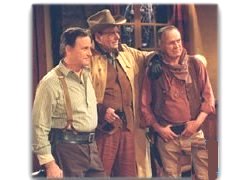
Clint was lured out of retirement several more times to reprise his role. Executive Producer Frank Valentini convinced him, in response to fan demand, to return for a one-episode “fan fantasy” in February 2003. Clint thoroughly enjoyed his brief return to New York City to work with old pals Phil Carey and Robert S. Woods in “The Buchanans Ride Again.” Another short stint coincided with the show’s 35th anniversary. He last stepped in front of the cameras in 2004 for a storyline involving “Viki’s” receipt of a donor heart.
Until his death on January 31, 2009, following a brief illness, Clint remained active at Happy Horse Ranch, where there was always something to attend to, whether it was one of the many animal residents, a sprinkler system, a fence in need of mending or another chore. On any given day, the Happy Horse Family included 40 horses, two dogs, and too many cats to count. Although Clint frequently declared quite emphatically that he didn’t “want to own anything else that eats,” any animal in need of a home always found one at Happy Horse. His dogs were his constant companions, making themselves at home inside Clint’s sprawling, comfortable house. He laughingly told visitors, “This isn’t a house. It’s ‘Clint’s Kennel!'”
Despite his retirement, Clint’s Official Fan Club continued to thrive, in no small measure due to Clint’s continuing dedication to and appreciation of his fans and their fond recollection of his more than twenty years of understated, moving performances.
Writer Michael Logan once declared that the role of Clint Buchanan, along with those of Asa and Bo Buchanan, should never be recast, opining that no one but Clint could successfully play the “signature role.” Clint’s fans couldn’t have agreed more.
Clint’s professional legacy is his “Clintessential” contributions to “One Life to Live.” His personal legacy is the fact that his big heart, matched by his “bigger-than-life” cowboy persona, loyalty, and steadfast support is greatly missed by his family and friends.